How to Paint Leather Shoes
Author: Cheryl Kilbourne-Kimpton
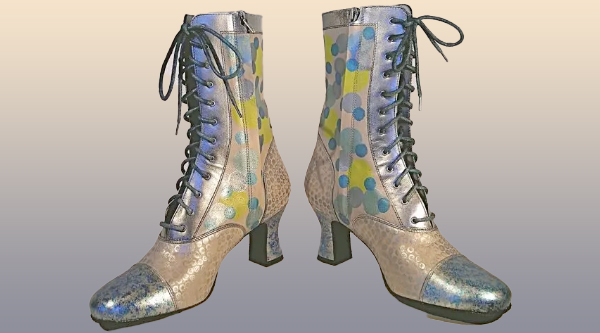
Seibu Department Stores, Sapporo Japan
Among the most frequent topics our customers ask about is how to paint leather shoes. Some want to take their “kicks” from dull to “daaaaymn!” or, maybe, they are faced with turning a hundred pairs of neutral character shoes into custom creations.
The design is limited only by your imagination, but I can help you with the nuts and bolts. Anthony Hoffman, a professional shoe painter, is who I turned to as our guide. His painted creations have appeared on numerous Broadway shows including the Tony award winning productions Shrek, Hairspray and Wicked. He has also been tapped to create special displays heralding the opening of a major Japanese Department Store’s new shoe department.
WHAT YOU WILL NEED:
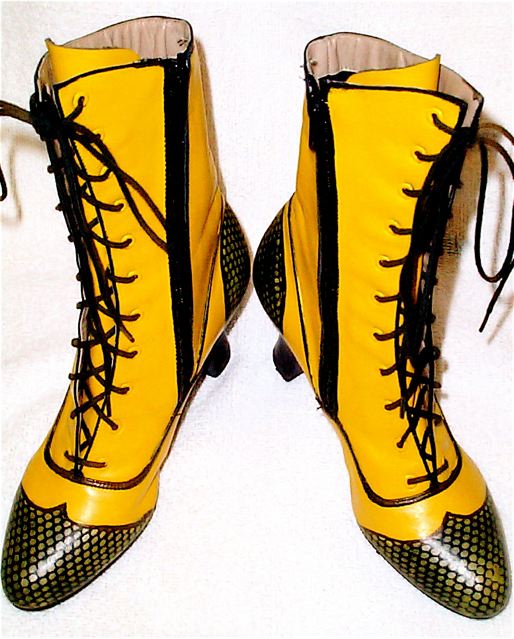
WICKED Designed by Susan Hilferty
- 99% Alcohol
- Angelus Professional Leather Paint
- Paint Brushes
- Meltonian Shoe Cream
- Terry cloth rag or old washcloth
- Heavy Duty Protective gloves
- Protective Mask
- Air tight jars
- Masking Tape
- Hair Dryer
- Optional-Angelus Finishes
- Polishing rag or old pantyhose
The first term everyone learns in a professional kitchen is “mis-en-place” which translates “have all your stuff together”. Well, that principle is essential in this process as well. You must have all your ingredients in place in a well ventilated, properly lit area. If possible take your work outside. Your work table should be well covered as well.
Step One: Prep
- Remember the quality of your prep has everything to do with the quality of your paint job.
- Most instructions start by removing the waxy finish, dirt and oils with deglazer or preparer or if your are seriously changing color, using acetone to strip the color away. The only problem with this method is that these products are flammable and quite volatile with toxic fumes. This intense “stripping” also changes the basic character of the leather, raising the “tooth” on a smooth leather making it feel almost like suede.”It destroys the integrity of the leather,” Anthony believes, so he likes to take a much gentler approach. He uses 99% Isopropyl Alcohol to strip the shoes before painting. He only “breaks” through the top layer of the finish on a new shoe meaning that he does not find it necessary to completely remove all of the color from a shoe that he is painting. He prefers using an old washcloth or a terry cloth rag instead of a smooth rag as its’ slight abrasiveness assists in removing the finish. Remember Alcohol is highly flammable as well, but the fumes are far less toxic. You still must work in a well-ventilated area and stay away from open heat sources. While some professionals don’t wear masks, it is recommended and essential for anyone with a respiratory problem. All the pros, do, however, wear gloves, between the danger of burns from the alcohol and the staining of the paint on your hands it’s just foolish not to.
- After the alcohol evaporates (approx. 5 to 10 minutes) you are now ready to move on.

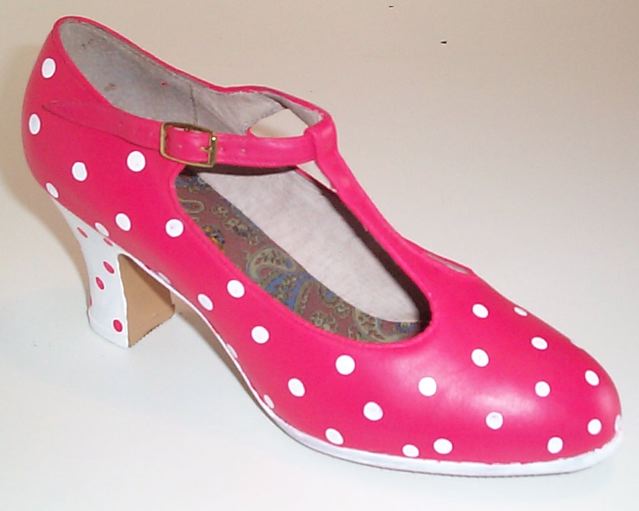
HAIRSPRAY Designed by William Ivey Long
Step Two: Paint
Painting can be a time consuming process. Your choices are patience or frustration from cracked and flaking shoes.
- Use masking tape to mask off any areas that you do not want to paint,
- Anthony uses Angelus Leather Paint, but instead of using it as it comes out of the bottle he thins it down with water until, he says, “it is the consistency of ‘Bisquick’ [or pancake batter].”
- Anthony likes to paint 3 thin coats. Several thin coats wear better than a couple of thick ones and offer more control over flaking and cracking,
- Apply paint with short even strokes being careful to smooth out the edges to avoid getting ridges. Anthony uses angled brushes to facilitate that.
- After he finishes painting his first coat Anthony uses a hair dryer to assist in the drying process. A dryer does two things. First it “shrink wraps” the paint to the shoe and second, it smooths out any unwanted brush strokes by melting the paint right into the prepared leather.
- When applying the next coat Anthony suggests that to achieve better coverage you should brush on the paint in the opposite direction from the first coat, i.e. if you paint the first coat heel to toe, you should apply the second coat perpendicularly across the uppers of the shoe.
- Dry this coat with a hair dryer as you did the first.
- Apply the final coat, once again alternating direction from the second. After you dry this coating with the hairdryer you are ready for the next step.
Step Three: Protect
Finishes serve two purposes. They add protection that preserves your paint job, and they can also give your shoes a matte or glossy surface. Although Angelus makes several finishes from which to choose, Anthony prefers to finish his shoes with Meltonian shoe cream. After application Anthony’s preference is to buff the shoes with pantyhose, but you can use a soft cloth or old tee-shirt – the more you buff, the higher the gloss. If you want to ramp up the color or shine of the finished product, let’s get creative.
Getting Creative:
-
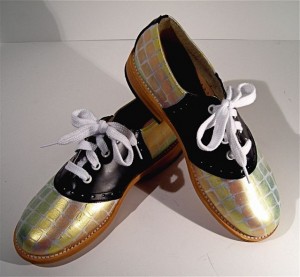
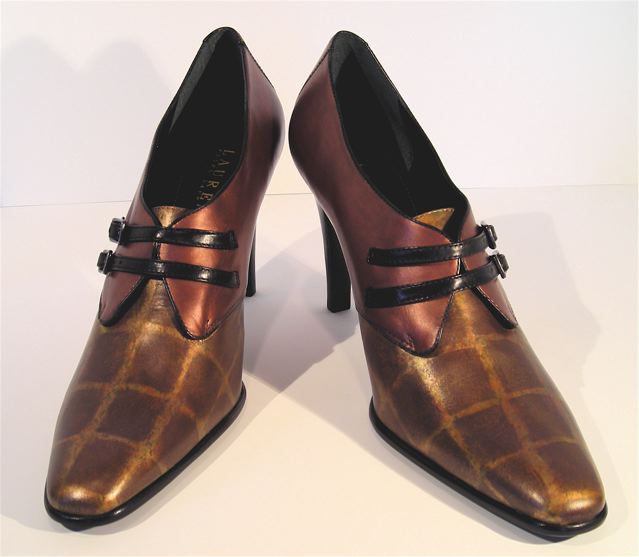
Seibu Department Store Sappora Japan
If you like the color that you have painted you can use a neutral Meltonian polish as a finisher. If you want to”kick it up a notch” and enhance your color you can use the same color or slightly different color Meltonian shoe cream (they have a broad and complementary color palate) to finish your shoe. This is where the fun and challenge begins. It takes trial and error to get the look you want and probably some knowledge of color theory. Please, don’t come this far only to ruin your product – be judicious as you customize the finish. You can always go back and repeat the process with a touch more color.
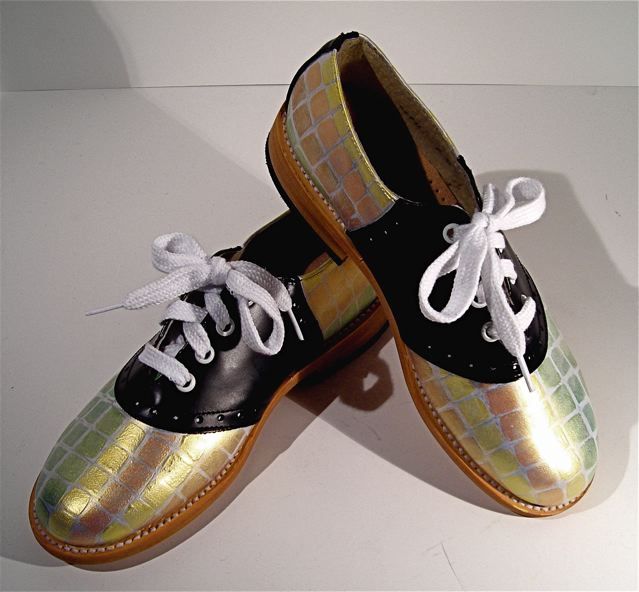
- If you want your shoes to have a really high sheen you can mix your base color into metallic paint such as silver or gold. You need to judge the proportions by eye until you achieve the desired shade, once again be prudent with your metallic additions.
OTHER TIPS
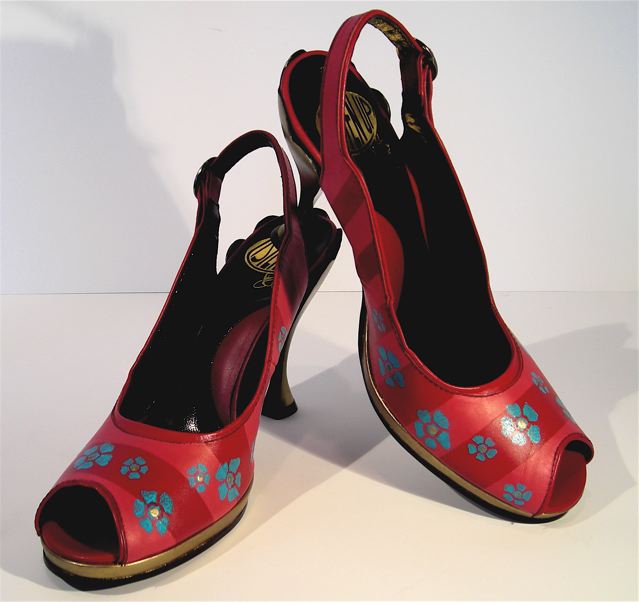
- If you are painting delicate, soft or worn shoes, stuff the toes with newspaper or plastic bags to create a smooth surface.
- If you were painting a light color over a dark wall at home you would have to prime the wall first, it is the same with shoes. If you are lightening up a black or other dark shoe “prime” it with a first coat of white or, at least, neutral. This is particularly important if you are painting with a metallic or neon paint.
- If you are painting with metallic colors, use a “base coat” in a similar, yet non-metallic shade. This will provide a more even surface for the metallic coat.
- If painting shoes in multiple colors, start with the lightest color first, then progress to the darker color. If you make a mistake, it’s easier to hide it by painting dark over light rather than vice versa.
- Use good quality brushes not wool daubers for painting. Daubers are meant for applying dye or polish, not paint and the angled brushes minimize stroke marks. The brushes do not have to be natural, synthetic is fine.
- When creating custom colors, mix them up before painting, store in airtight containers and be sure to write the formula down.
- Anthony has a final suggestion which harkens back to the famous journalist Don Hewitt and an acronym he drilled into his correspondents, “KISS” = Keep It Simple, Stupid! With no offense meant, that should be the watch phrase for this project.
As with many crafts there are many different approaches. This is a great opportunity for us to create a dialogue. Please, post your comments, suggestions and your personal tricks.
Cheryl (with roger kimpton)
This was a great article, detailed enough to allow an amateur to give it a try, but not so technical to scare a novice away.
I actually have personal experience using these techniques taught to me by Mr.Hoffman, himself. I was recruited by my niece’s dance troupe to take their “plain jane” tap shoes up a notch for their upcoming competition. We actually turned run of the mill tap shoes into saddle shoes following these same techniques. The finished product was fabulous and heralded rave reviews from the spectators and competition judges alike.
Thank you Tony, for helping me to make their dance troupe stand out above the rest!
I could recognize that work from a mile away. I was In the Broadway Company of Hairspray and I still rave about the show I go to wear in the show. IN fact when people came to see the show the commented on my FIERCE shoes. So I guess in short I’m saying I LOVE his work. I also saw him paint a par of boots for a newborn as a baby shower gift and that was truly precious. I was jealous that didn’t have a pair. I had never seen the department store wort assured that I’m surfing the internet to find where I can buy a pair. If you or anyone knows, please post because I know lots of folk that would love these shows. I mean think about it. Great quality, the work will last, fierce shoes, and truly an expression of yourself and ART!!!
Thank you to “the nicest kid in town”! Hairspray was a seven year commitment to William Ivey Long’s Tony Award winning show. Mr. Ivey Long’s shoe designs evoked character with humor and were rich with detail. His shoe designs are NEVER an afterthought, and it was a joy to recreate them for him and his design staff.
I first painted for Mr. Ivey Long on Steel Pier and it is his encouragement of my talent and the attention to shoe continuity I see as a goal I strive for.
Good luck at Hair Arbender and give my best to John and Amelia.
I’m an artist and tango dancer – I re-create old tango shoes (talk about works of art) and have been using the dyes/paints from MW for a couple yrs now. Absolutely love this article – wish that Mr. Hoffmann wld journey to Chicago and give workshops. In any case, I’ve learned some great tips from his article and look forward to the future of this blog.
Luanne, my bags are packed for Chicago! Just send the tickets and cash. Lot’s! 🙂
I was lucky enough to dress Grand Hotel (many thanks Alyce Gilbert) years ago with the fabulous Pierre Dulaine and Yvonne Marceau, the ballroom stars? Have you heard of them?
If you have anymore questions just ask…
Very fashionable shoes. I love it, all of them. And thank you for great tips. It is a big help regarding on shoes. Thank you!
i really enjoyed this article it is very helpful i only had one question. Do you apply satin finisher first then the meltonian or are you supposed to use one or the other as a finisher?
Well, this is an elite group! I have stumbled in, searching for a way to dull a snazzy pair of metallic boots…from distressed silver/pewter to a bit more matte gray. They’re great as they are, but I got one too many people reminiscing about their Halloween “Tin Man” costume. Suggestions?
YAY! After searching WAY too long for the perfect pair of ivory wedding shoes, I’m just going to paint a comfortable pair of heels I already own in the Angelus “Vanilla” color. What a relief that this is even an option! Thanks for sharing 😀
Avoid applying heat to dry a shoe quickly. The cracks will become more severe. Place the leather shoes outside, free from any direct sunlight and rain, and allow them to dry with natural air.
Thanks! I am going to paint some boots!
Anthony, Great article. I discovered that ethyl alcohol works much better on acrylics. It strips them better. It’s a little more expensive, but saves a lot of work. It can be bought at any drugstore, or, Tommy may carry it. As for the concerns people have about using a hairdryer. Use it on the lowest heat setting and the highest airflow. In almost 30 years of painting with acrylics, I’ve never fried or shrunken a shoe. And the meltonian top coat keeps them from cracking.