Fluctuating Cotton Prices Touch Us All
Author: Cheryl Kilbourne-Kimpton
If ever there was an illustration of the world evolving into a global economy, the state of the international cotton market fits the bill. Global or not, the impact is quite local, just walk the aisles of MWS for proof. The fiber’s price has more than doubled in the past year alone. At a cost hitting the $2.20 mark, the U.S. saw prices exceed real dollar values of those during the blockade of the American south during the Civil War, meant to strangle the Confederate economy. At that time the United States’ was the world’s cotton basket.

“I’ve seen a lot of big moves, and this exceeds everything,” Sharon Johnson, senior cotton analyst at First Capital Group, told the Wall Street Journal. “It’s not something you’re going to see [again] in your lifetime.”
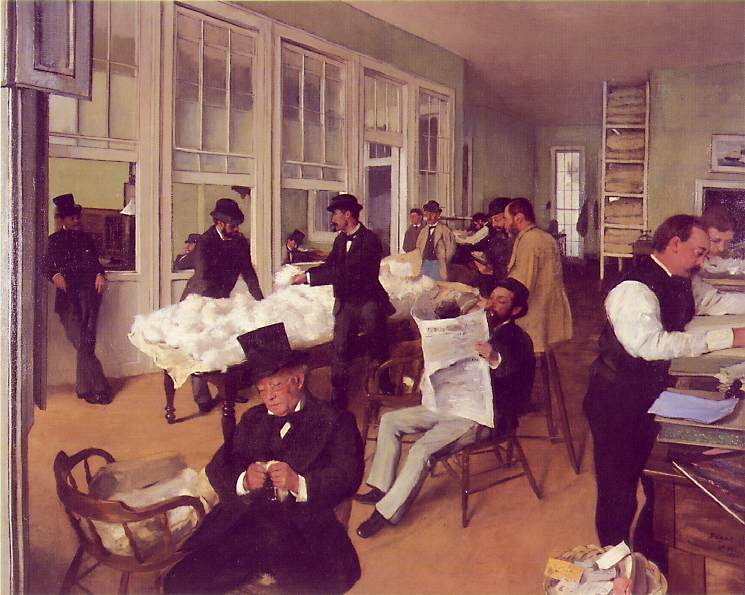
Edgar Degas painting of his uncle’s New Orleans cotton firm (1873)
The price did, in fact, drop $1.07 on July 7 landing at $1.13. “I think the reality of the matter is that cotton, at $1.13, is not overly expensive,” says Mississippi State University Agricultural Economist, A.O. Cleveland, Jr., “but then, neither is it cheap.” Bloomberg News, however, reports a somewhat more bullish price of $1.09 on 12 July showing the lowest and projected to be transitory price. Still, this is certainly not the gentle $.80 which was the consistent high-end price for years.
Regardless, corporations like Hanesbrands which manufactures a staggering 500 million tee shirts and one billion socks per year, “locked” into prices between $1.60 – $1.80 on the futures exchange because of inventory requirements so we are stuck with these prices until next year. Sadly, however, Newton’s absolute law that, “what goes up, must come down” is consistently belied in the marketplace.
Many of the factors affecting the market are beyond our control. Last year draught ravaged the crop in China, the world’s largest cotton producer. At the same time, inordinate rainfalls and flooding pummeled Pakistan and India resulting in serious shortfalls in their crops. India, the second largest cotton producer, further exacerbated the problem by limiting cotton exports to insure domestic producers sufficient raw material. The United States, however, had an excellent crop last year. It seems, however, that we no longer dominate the market sufficiently to affect the price.
This year we are seeing a reversal of fortune in the market. Regardless of China experiencing a dramatic winter draught which delayed planting, they are projecting a substantial improvement in this year’s harvest. Pakistan, as well, is reporting a pronounced increase in growth this year. India, the last of the “big three”, is planning to suspend their export limitations. The United States is having a bad year, however, as a result of draughts in Texas, our largest source of cotton.
Less well known growing regions like Australia, Brazil, Sub-Saharan Africa as well as the Asian sub-continent having picked up the U.S. slack contributing to the drop in the price.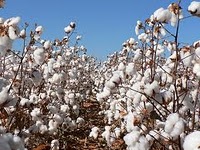 The problem in this country is compounded by the reality that cotton must compete with other equally profitable crops like corn (used for ethanol) and soy. After last year’s soaring price, many Texas farmers planned to reapportion their land to plant more cotton. Then the draught hit. “In 1973, they had what at the time was a record crop, 338,000 bales,” Prof. Cleveland explains. “In 1974, they had a drought very similar to the one now in progress and they harvested only 32,000 bales. They lost 90% of their crop.”
After exports, we could find ourselves with a mere 1.5 to 2 million bales for our use. Global production, however, is expected to be up 10 million bales, with only a 4 million bale projected increase in consumption.
The Chinese economy is a key variable in this delicate equation. There interest rates are in flux which has resulted in a temporary reduction in the nation’s expanding consumerism. “Chinese and Indian consumers,” Prof Cleveland says, “are now pulling the demand/price wagon,” after years of American hegemony. It was the surge in Chinese consumerism that drove the price up and a softening of Chinese shopping a major contributor to the dip.
Many economists feel that the Chinese period of instability is the result of strong infrastructure improvements, construction and education. In the long run they view the economy as strong.
Of course, our domestic economy is troubling to the market. Obviously, right now the dollar is not considered exactly rock solid.
For the moment, there is consensus that we’ll be facing prices well over a dollar for the foreseeable future. Hanes has already instituted price increases for the back-to-school inventory and it looks like they will add to that with the coming year. They are not alone, other manufacturers who lack the buying power of Hanesbrand will are planning hikes steeper still. Retailers are trying to absorb some of these increases to assuage the concerns of wary consumers who are just now returning to the mall. Even if the consumer doesn’t immediately feel the impact, the retailers tenuous profit margins will be impacted.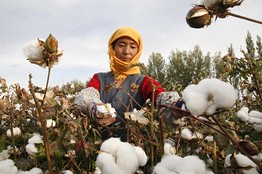
Some manufacturers are incorporating synthetics into their fabrics to offset the increases, but that’s not always possible – who wants a synthetic tee-shirt. In the case of MWS, our muslin hangers, a workhorse of every wardrobe department, cannot be made of a blend, explains Cheryl, because the fibers would be so tight it would be difficult to pin on the run. “Our supplier passed along increases that required us to up the retail price,” she said. Like most small retailers our profit margin is trimmed to the bone.
While the market has improved over last year, there are lessons to be learned. One is that commodity markets are no longer driven primarily by any one nation, instead they are a global market. Second, sorry, Sir Isaac, this apple is not going to truly come down in the foreseeable future.
Roger Kimpton