Ruth E. Carter: Crafting Legacy Through Costume Design
Author: Emily Battles
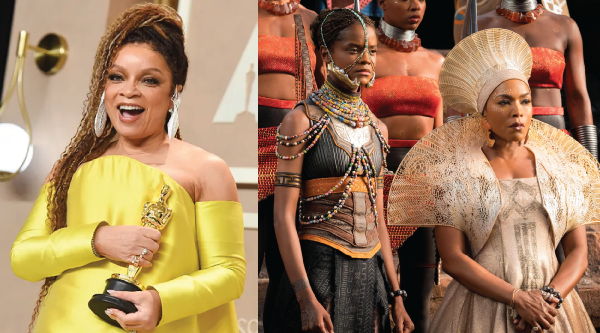
Few costume designers have a history of crafting legacy through costume design quite as profoundly as Ruth E. Carter. With a career spanning more than three decades, Carter’s work stands at the intersection of meticulous historical research, cultural storytelling, and visionary design. This year, her legacy achieved a historic milestone when she became the most nominated Black woman in Academy Awards history — a recognition that celebrates both her remarkable accomplishments and her transformative influence on the art of costume design.
Courtesy of Gilbert Flores for Variety and Marvel Studios
Foundations of a Master Designer
Courtesy of Columbia Pictures
Born on April 10, 1960, Ruth E. Carter’s path toward costume design began early. At the age of nine, she learned to sew and interpret patterns through the Boys & Girls Club, developing technical skills that would later define her precision and craftsmanship. She went on to graduate from Technical High School in Springfield, Massachusetts, and earned a Bachelor of Arts in Theatre Arts from Hampton University.
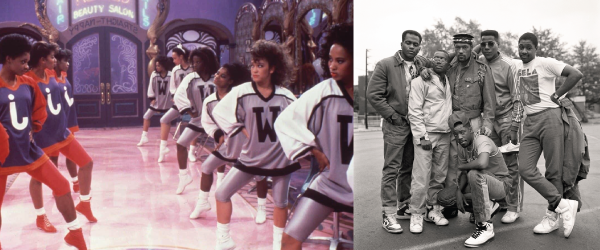
Following her studies, Carter honed her craft in theater costume departments, first in her hometown and later at the Santa Fe Opera. In 1986, she relocated to Los Angeles, where her career took a pivotal turn after meeting filmmaker Spike Lee at the city’s Theater Center. Their collaboration began with School Daze (1988) and quickly evolved into one of the most influential creative partnerships in modern cinema.
Crafting Legacy Through Costume AND Collaboration
Courtesy of Universal Pictures and Warner Bros
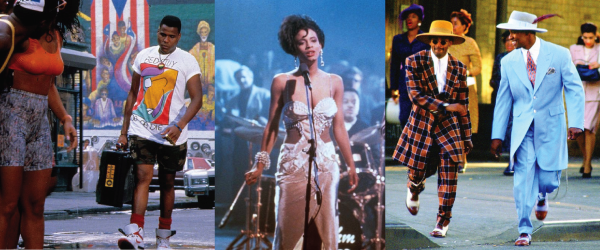
Carter’s work with Spike Lee—including Do the Right Thing, Mo’ Better Blues, Jungle Fever, and Malcolm X—did more than dress characters; it articulated identity, politics, and cultural nuance. Her costumes grounded these films in authenticity while elevating their visual language, making clothing a central narrative force rather than a decorative afterthought.
Her ability to move seamlessly between contemporary realism and historical drama led to further collaborations with directors such as John Singleton and Ryan Coogler. With each project, Carter demonstrated an extraordinary command of period detail, symbolism, and texture—qualities that have become hallmarks of her work.
Wakanda and a Redefinition of the Genre

Courtesy of Marvel Studios
Carter’s designs for Black Panther (2018) marked a watershed moment for both costume design and popular culture. Drawing from diverse African traditions, contemporary Black expression, and Afro-futurist aesthetics, she created a visual world that was both rooted in history and boldly imagined. The result was transformative.
Her Academy Award win for Black Panther made her the first African American to win an Oscar for Best Costume Design, as well as the first Marvel film to receive the honor. She would later win again for Black Panther: Wakanda Forever (2022), confirming the lasting impact of her vision.
In her acceptance speech, Carter captured the significance of her work with clarity and grace: Marvel may have created a superhero, but costume design transformed him into a king.
Recognition, Records, and Continued Excellence
Courtesy of Warner Bros
Beyond the Oscars, Carter has been widely celebrated by her peers. At the 2019 Costume Designers Guild Awards, she received Excellence in Sci-Fi/Fantasy Film for Black Panther, along with a Lifetime Achievement Award recognizing her enduring contributions to the field.
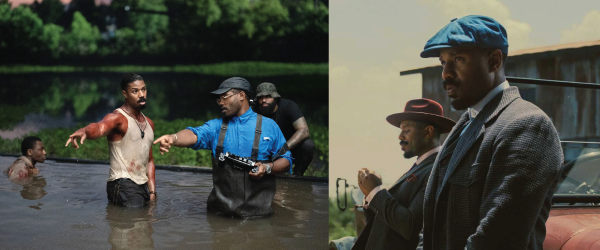
Her most recent Academy Award nomination for Sinners (2025) placed her in the record books once again, making her the most nominated Black woman in Oscar history. While the designation may be described as a “dubious honor,” it more accurately reflects a career defined by consistency, innovation, and cultural significance.
An Enduring Influence
Ruth E. Carter’s work reminds us that costume design is not merely about clothing—it is about context, memory, and meaning. Her designs educate, inspire, and challenge audiences to see history and identity through a richer visual lens.
At Manhattan Wardrobe Supply, we recognize and celebrate the artists whose dedication to craft elevates storytelling at every level. Ruth E. Carter’s career is a testament to what is possible when artistry, discipline, and cultural understanding come together. Her influence will continue crafting a legacy through costume—and cinema itself—for generations to come.